
Should I Sell My Gun? An Answer for Gun Owners

Here’s the honest answer: consider selling a gun if it’s often unused, duplicates a role in your collection, or no longer fits your needs or budget.
But that’s just the simplified version. The decision depends on actual use, current value, and personal attachment to the piece. Your beat-up 9mm is different from a 1950s hunting rifle your father passed down to you.
This guide walks through how to weigh the factors, with insight on the used gun market, to help you decide if you should keep or sell your guns.
We buy guns! Fast. Safe. Legal.
"They paid me 3x more than what my local gun shop offered'
Why You Should Sell Your Gun
Many shooters own more firearms than they regularly use. From AR-15s bought during panic buying phases to extra hunting rifles gathering dust, collections expand over time.
Here are common reasons selling makes sense once the collection starts to get sizeable.
Changing Interests
Your shooting life evolves. Maybe you moved from waterfowl hunting with a shotgun to PRS matches with a precision rifle. Or you shifted from collecting revolvers to defensive carbines.
Holding onto stuff from a previous phase ties up money and safe space. Selling lets you fund what you actually enjoy now, not yesterday.
Upgrading Your Setup
Selling an underused gun can finance a better optic or other upgrade that you can actually appreciate. It may even let you buy guns you like more.
Many folks find that selling two mid-tier rifles to buy one quality piece improves their shooting experience more than keeping everything. If you have a gun you really want and own several you’re lukewarm about, it just makes sense to sell the latter.
Financial Reality
Sometimes you need money for life expenses. There’s nothing wrong with freeing up cash to reduce debt or cover an unexpected cost.
Guns are assets. Like other assets, they can be liquidated when something else is more important.
Relocating
Moving to a new state can change what’s legal to own or practical to use. If you’re heading somewhere with different rules on long guns, magazine capacity, or features, selling before the move simplifies the transition.
Life Events (Rarer)
Retirement, downsizing a home, or making an estate plan can trigger sales. Unless they’re also gun people, you may not want your wife or kids stuck guessing what to do with a 20+ gun collection after you’re gone.
Redundancy in Your Collection
Own three similar 9mm polymer pistols? Two nearly identical .308 bolt guns? That’s a reasonable trigger to sell one.
Selling an underused gun to fund ammo, range time, or instruction often increases overall enjoyment of the hobby. You’re not losing anything you actually miss.
Value Spikes
Here’s something many sellers miss. It may be wise to sell a gun that has no sentimental value or special utility if you notice its resale value peaking or interest in it spiking.
These are usually temporary. Election years or manufacturer discontinuations can create short windows. If you act fast, you can take advantage and get more than the gun would otherwise fetch.
Look at how used gun prices crashed from 2024 to 2025 for many popular models. Trade-in floods caused older semi-auto handguns to sell for 30-50% below peak values, for example.
If you’d sold during the spike, you’d have done much better.
CAVEAT: When assessing gun value, prices seen in forums or at gun shows are often asking prices, not actual sale values. Your buddy wanting $2,500 for his used DDM4 doesn’t mean that’s what it’ll actually bring.
An easy way to gauge your gun’s value is to get an online offer from Cash for Arms. We’ll often send it within hours of you submitting the online form. We use market-based pricing and a best price guarantee, so it’s an easy way to verify if selling makes sense numerically.
Get a FREE Appraisal and Offer
If you're thinking about selling a gun, you'll need to discover its true market value. We're appraisal specialists who can give you a free valuation and offer.
Why You Shouldn’t Sell Your Gun
As industry professionals, we sometimes advise clients not to sell some firearms. Here’s when keeping makes more sense than cashing out.
Family Heirlooms
That rifle your father taught you to hunt with? The revolver your gramps carried? Don’t sell them!
The connection to family and personal history can’t be replaced with money. Some guns belong in your safe permanently.
First Guns
Your first hunting rifle or the handgun you learned to shoot on carries meaning beyond its market value. Selling it often leads to regret that a few hundred dollars won’t fix.
Rare and Appreciating Models
Very rare, high-demand, limited-production runs may be worth holding if there’s reason to think they’ll continue to appreciate or you'll want to keep them as collector's pieces.
Pre-lock S&W revolvers, certain pre-ban ARs, and first-year Colt Pythons fall into this category. Former owners often wish they’d kept these 5-10 years later.
Hard-to-Replace Models in Restrictive States
In states like California or Massachusetts, older standard-capacity pistols or rifles that are no longer on approved rosters become impossible to replace once sold.
If you live somewhere with a regulation that restricts certain features, think twice before letting go of grandfathered guns.
Proven Reliable Defensive or Competition Guns
If a gun is used regularly for defense, competition, or seasonal hunting and has proven reliable, replacing it can be more trouble than it’s worth.
You’ve already worked out the kinks. You know the trigger and how it runs with your preferred ammo. Starting over costs time and money.
The Regret Factor
Some guns are once-in-a-lifetime pieces. OWA Colt SAAs. A great-condition Garand. Vintage Winchesters.
The world of firearms has categories where supply is fixed and demand only grows. Selling these to chase a short-term need often feels like a mistake within a few years.
Timing and Delays
Sometimes, it’s not that you shouldn’t sell the gun. It’s just that you shouldn’t sell the gun yet.
Seasonal patterns affect value. Hunting rifles often move better before fall seasons, for example. If you can wait for the right window, you may net a better price.
Our goal is helping you make the right decision, not just completing a transaction.
Questions to Ask Before You Sell a Firearm
Before you post a listing or request an appraisal, run through this checklist. It takes 5-10 minutes and can save you from a decision you’ll regret.
- When did I last shoot this gun?
- Does this gun fill a unique role?
- Is there sentimental or family value?
- Does it actually fit or perform for me?
- Can I replace it later at a similar price?
- Are there legal factors to consider?
- Is there anything better I can get to replace it?
If You Choose to Sell a Gun: Cash for Arms Makes It Easy
Many sellers want to avoid meeting strangers, lowball offers at a pawn shop, and paperwork confusion. They also want strong market-based payouts.
Cash for Arms solves that problem.
How the Process Works
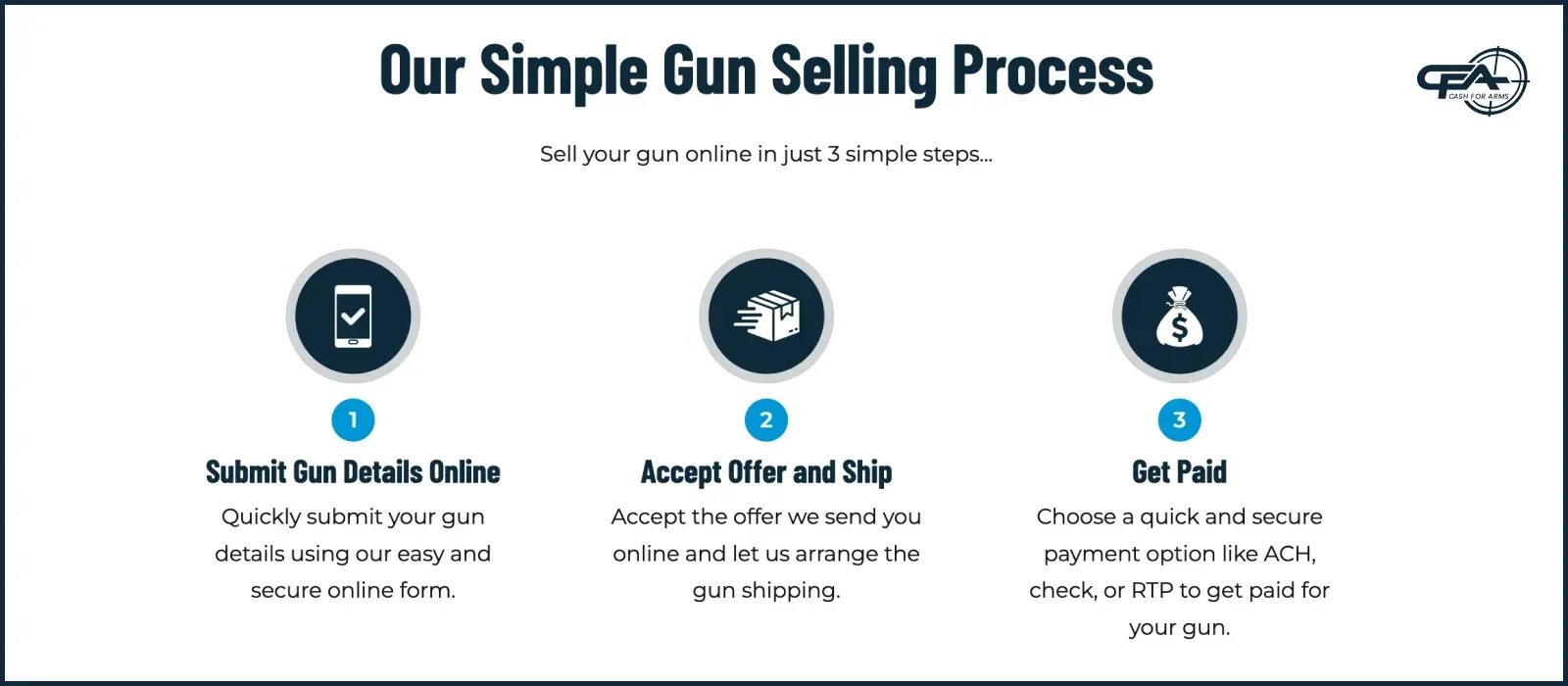
Step 1: Fill out our online form with details about the gun and its accessories.
Step 2: Our in-house firearm professionals check the national markets to send you an offer, followed by prepaid shipping labels to send us the gun if you accept.
Step 3: We pay you in your preferred payment method.
If You Accept
We cover shipping. Cash for Arms provides prepaid, insured shipping labels and detailed packing instructions. You can even get courier doorstep pickup for the package.
We handle compliance. FFL-to-FFL transfers, state and federal law verification, and eventual resale are all managed by our team. You don’t have to navigate carrier policies or ATF rules on your own.
We protect your time. No listing, no messaging buyers, no meeting at a gas station parking lot.
Consignment Options
If you prefer to maximize sale price rather than take a straight cash offer, we can discuss consignment.
This makes sense for sellers willing to wait, and where a little extra time on the market could yield significantly more.
Get a No-Obligation Offer Fast
Show us your gun and we'll shoot back an offer as fast as possible. No hassle, no fuss, and no low-balling.
Conclusion: Making a Confident Decision
Selling can be the right move when a gun is unused, redundant, or no longer fits your goals. It frees up capital too.
But heirlooms, rare pieces, and proven-reliable defensive firearms may deserve a permanent spot in your safe, on the other hand.
If you’re still uncertain, use Cash for Arms as a low-friction way to get a professional offer. Shipping is covered. There’s no obligation. It’s simply good information for your decision.
We buy guns! Fast. Safe. Legal.
"They paid me 3x more than what my local gun shop offered'
Disclaimer: We aren’t lawyers and this guide is for general information, not legal advice. Consult a lawyer if you need the latter. We can’t guarantee the information here is always current or accurate. You’re responsible for following laws in your area.